
Towcester Going Conditions: How Sand, Weather and Gradient Affect Times
Best Greyhound Betting Sites – Bet on Greyhounds in 2026
Loading...
Going conditions at Towcester can shift a dog’s finishing time by half a second to two full seconds. That range is large enough to overturn form ratings, reverse predicted finishing orders and turn a comfortable winner into a beaten favourite. No other single variable has as much impact on Towcester results as the state of the sand underfoot — and yet many punters treat going as an afterthought, something to note rather than something to act on.
The ground beneath the race is the foundation of everything that happens above it. Understanding the going scale, how Towcester’s gradient compounds its effect, and how to adjust form figures accordingly is not optional knowledge for anyone who takes betting on greyhounds at this venue seriously.
The Going Scale: Normal, Slow, Fast and Beyond
The going at Towcester is assessed before each meeting by the racing manager and expressed on a numerical scale. “Normal” is the baseline — the standard condition against which all other readings are measured. A normal going figure of zero means the surface is running true to its expected pace. Deviations from normal are expressed in hundredths of a second: a going of -10 means the track is fast (dogs will run a tenth of a second quicker than on normal going), while a going of +30 means the track is slow (dogs will run three tenths slower).
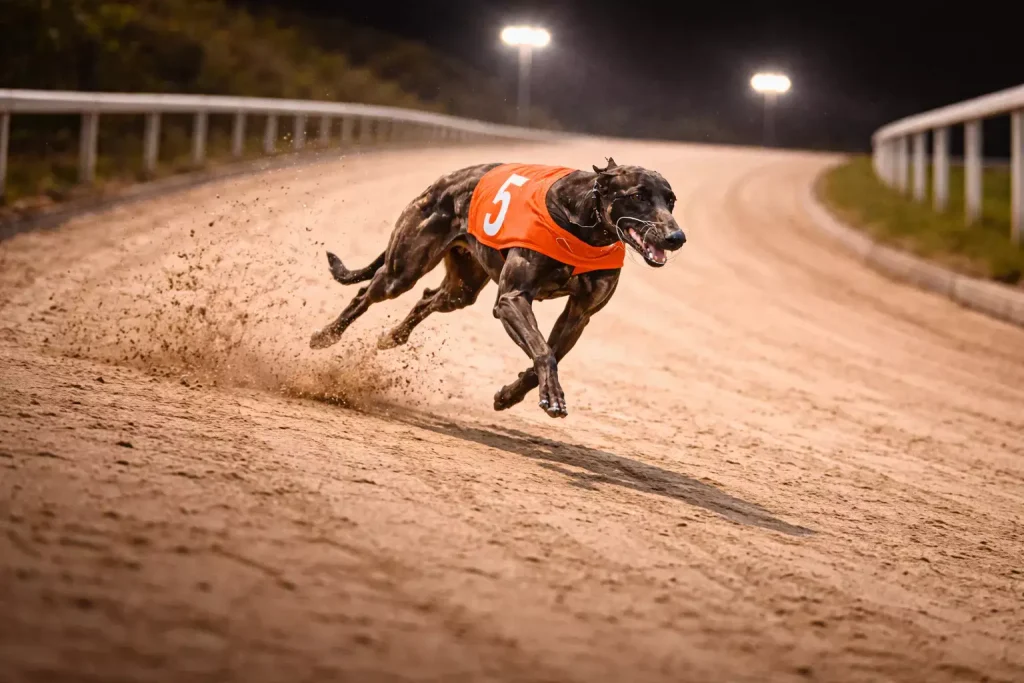
The surface itself is sand — a material whose behaviour changes dramatically with moisture content. After rain, the sand absorbs water and becomes heavier, creating more resistance with every stride. In dry conditions, the surface firms up and the sand particles compact, producing a faster running surface. Temperature also plays a role: cold nights can harden the top layer of sand, while warm afternoons can leave it loose and grippy.
Towcester’s management invested heavily in surface quality during the 2026 overhaul under Orchestrate’s new stewardship. Approximately 300 tonnes of new sand were added to the track, alongside new maintenance equipment including tractors, graders, harrows, rotavators and water bowsers. James Chalkley, Head of Racing at Towcester, described the approach as going back to basics with the surface, with the explicit aim of delivering a track that is as safe as possible for the greyhounds to run on. The investment has produced a more consistent surface, but going variation remains an inherent feature of any outdoor sand track — it cannot be eliminated, only managed.
For punters, the going report should be the first thing you check before studying the racecard. It is published before the meeting and is available on bookmaker sites, Racing Post and the GBGB. If the going is significantly different from the conditions under which your selected dog produced its best form, that mismatch is a red flag. A dog whose three best runs all came on fast going is a risk on a slow night, regardless of how impressive those times looked on paper.
How the 6 m Gradient Compounds Going Changes
At a flat track, a going shift from normal to slow adds a broadly uniform time penalty across the circuit. Every section of the race gets slightly slower, and the total time increase is predictable. At Towcester, the 6-metre elevation change to the finishing line disrupts that uniformity. The uphill section is where dogs are already decelerating, and slow going adds drag precisely where the animal is most vulnerable.
The result is an asymmetric time penalty. On the flat sections of the circuit, slow going might add 0.1 to 0.2 seconds per 100 metres. On the uphill section, the same going shift can add 0.3 to 0.5 seconds over the same distance, because the combination of gradient and heavier sand forces the dog to work substantially harder to maintain forward momentum. The construction of the track — built from 60,000 tonnes of imported earth to create the elevation profile — means this gradient is a permanent feature that interacts with every going change throughout the year.
This compounds over distance. At 260 metres, where the gradient impact is minimal, the total going effect is small. At 500 metres, where the uphill finish is fully engaged, the going can add 0.7 to 1.0 seconds on a slow night. At 906 metres, where the gradient is encountered three or more times, the cumulative effect can exceed two seconds. These are not marginal numbers — they are large enough to reshape the competitive order of a race and render form from different going conditions fundamentally incomparable without adjustment.
The practical implication is that going corrections at Towcester need to be larger than at flat tracks. If you are manually adjusting form figures, the standard going allowance published with the results is a starting point, but it may understate the true effect on dogs that struggle with the gradient. A dog with a known stamina limitation — one that fades in its closing sectionals — will be disproportionately affected by slow going at Towcester, because the going penalty stacks on top of the stamina penalty on the same section of track.
Adjusting Form Figures for Going at Towcester
The calculated time published alongside Towcester results already adjusts for the official going. In most cases, it is the most reliable form figure to use for cross-race comparisons. But there are situations where the calculated time does not tell the full story, and a manual adjustment — or at least a mental adjustment — is worth making.
The first situation is intra-meeting going drift. The official going is assessed before the first race, but conditions can change during the meeting. An evening session that starts on normal going might end on slow going if rain arrives mid-card. The calculated time for every race on that card will be based on the pre-meeting assessment, which means the later races are under-adjusted. A dog that ran in race ten on deteriorating ground may have a calculated time that is two or three tenths slower than its true standardised performance.
The second situation involves dogs with pronounced running styles. The official going allowance is a track-wide average, but it does not differentiate between front-runners and closers. A front-runner that leads from the traps experiences the uphill section once, at the end of the race, when it is already tiring. A closer that sits in behind the pack and finishes fast experiences less total resistance because it is not fighting the sand at maximum effort for as long. On slow going, this difference is magnified: front-runners suffer more than closers, but the calculated time does not capture that asymmetry.
A simple framework: when comparing two dogs with similar calculated times, give preference to the one whose time was achieved on slower going. That dog was working harder for the same number. When tonight’s going is significantly different from a dog’s recent form, downgrade front-runners on slow going and upgrade closers on the same surface. These are probabilistic adjustments, not certainties — but at Towcester, where the gradient compounds every going shift, they catch real differences that the raw numbers miss.