Towcester Race Times: Full Schedule and Meeting Calendar
Best Greyhound Betting Sites – Bet on Greyhounds in 2026
Loading...
Since November 2026, when Orchestrate took over management on a ten-year lease, Towcester has operated five greyhound meetings per week under the PGR banner. That is more racing than most UK tracks offer — only a handful of venues match that frequency — and it means there are Towcester races to follow, study and bet on almost every day of the week.
For punters, this density is a double-edged sword. On one side, more meetings mean more opportunities. On the other, keeping track of when races happen, what type of meeting is running, and when first races go off requires a bit of organisation. This guide lays out the current weekly schedule, explains the difference between PGR and BAGS meetings, and highlights the key annual dates — including the English Greyhound Derby — that every Towcester follower should have in their calendar.
Weekly Meeting Schedule: Days, Start Times and Card Size
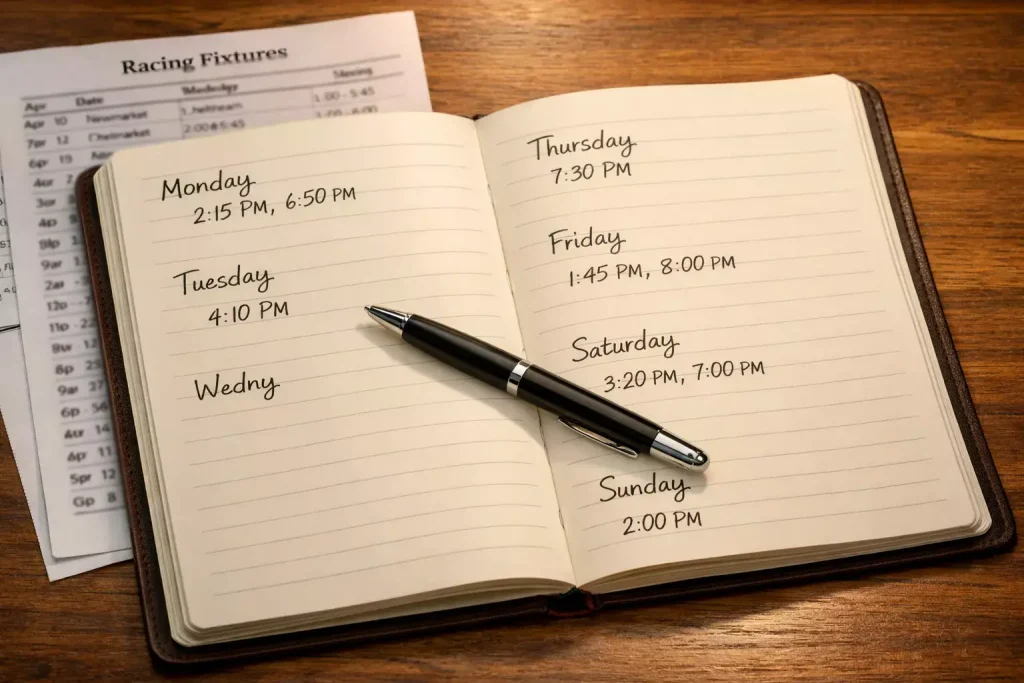
Towcester’s five-meeting-a-week schedule typically spreads across the working week and into the weekend. The exact days can shift slightly depending on bank holidays, special events and fixture list adjustments by PGR, but the standard pattern gives punters a reliable framework to plan around.
Meetings are split between afternoon and evening time slots. Afternoon cards generally begin around 13:00 to 13:30, with the last race finishing by 15:30 to 16:00. These are typically ten- or eleven-race cards. Evening meetings start later — usually around 18:00 to 19:30 — and tend to feature twelve or thirteen races, wrapping up by 21:30 to 22:00. The precise first-race time is confirmed on the racecard, which is published several hours before the meeting begins.
Card size matters because it affects the grade distribution. A twelve-race evening card has room for a wider spread of grades — from A-grade open races down to D4 — while a shorter afternoon card concentrates the field. For punters, longer cards offer more betting opportunities but also demand more preparation. Studying twelve races in detail before an evening meeting takes real effort; many experienced punters focus on four or five races where they have a genuine opinion and skip the rest rather than spreading themselves thin.
The transition from four to five weekly meetings happened when Orchestrate assumed control of the track. Previously, under the Henlow Racing management, Towcester ran Tuesday, Thursday, Friday and Sunday meetings. The fifth meeting — added as part of the PGR deal — slots into one of the remaining weekdays, and the exact positioning may vary by week. Checking the Racing Post fixture list or the PGR schedule at the start of each week is the simplest way to confirm which days Towcester is running.
One thing to keep in mind: first-race times can shift by fifteen to thirty minutes from their advertised slot, especially if a preceding meeting at another track overruns on the broadcast schedule. SIS manages the sequencing of all PGR meetings to avoid overlap on the streaming feed, so Towcester’s start time is sometimes adjusted to fit the national grid. If you are planning to watch from the first race, log in five minutes early and be prepared for a short delay.
PGR vs BAGS Meetings: What’s the Difference?
Two acronyms dominate the UK greyhound fixture list: PGR and BAGS. Understanding the distinction is useful for anyone trying to plan their week at the dogs or assess the level of competition at a given meeting.
PGR — Premier Greyhound Racing — represents the top tier of UK greyhound venues. PGR tracks host the highest-graded racing, the biggest prize money and the major competitions, including the English Greyhound Derby. Towcester’s entry into the PGR circuit was formalised as part of the Orchestrate takeover deal. Before that, the track operated under BAGS.
BAGS — Bookmakers’ Afternoon Greyhound Service — is the commercial operation that broadcasts lower- and mid-tier greyhound racing into betting shops and bookmaker platforms. BAGS meetings are the bread and butter of off-course greyhound betting: they fill the afternoon and early-evening schedule with a continuous stream of content for punters in shops and online. The racing at BAGS meetings is perfectly legitimate and regulated by the GBGB, but the average grade tends to be lower than at PGR venues, prize money is smaller, and the competitive depth of fields can vary more widely.
For Towcester specifically, the PGR status means several things. First, the grading is generally higher — you are more likely to see A-grade and B-grade races at a PGR meeting than at a BAGS venue. Second, prize money is better, which attracts sharper dogs and more competitive trainers. Third, PGR meetings receive more media attention, better commentary, and higher-quality broadcast production. Towcester’s 2 911 graded races in 2026 were run across this elevated platform, giving punters a substantial pool of high-quality form data to work with.
From a betting perspective, PGR meetings tend to produce tighter markets. The dogs are better known, the form is more widely studied, and prices reflect that. Finding value at a PGR meeting requires more homework than at a BAGS meeting where a casual form reader might not have bothered to check sectional times or going reports. The trade-off is that PGR form is more reliable — the standard deviation in performance is smaller at the top level, so your analysis is less likely to be undone by a random result.
Key Dates: Derby, Open Races and Special Meetings
The biggest date in Towcester’s calendar — and arguably in all of UK greyhound racing — is the English Greyhound Derby. The event runs across several weeks in the summer, with qualifying rounds and quarter-finals leading to a nationally televised final. The prize for the winner is £175,000, making it the richest greyhound race in the world. Towcester has hosted the Derby since 2021, and the contract runs through at least 2026, so this is not a fixture that is going anywhere soon.
Derby nights transform Towcester. Field quality is dramatically higher than regular graded meetings, with the best dogs from both Britain and Ireland competing. The atmosphere on the ground shifts too — hospitality suites fill up, the crowd is larger, and the media presence is noticeable. For punters, the Derby period is both an opportunity and a minefield. Opportunity because the form data on Derby runners is unusually rich — most will have run multiple qualifying rounds at Towcester, giving you several data points on the same track. Minefield because the fields are so competitive that small margins decide results, and the public market is well-informed.
Beyond the Derby, Towcester hosts various open races throughout the year. Open races sit above graded races in the hierarchy — they are not restricted by grade, so the best dogs from any level can enter. These events offer higher prize money than standard graded cards and attract stronger fields. The track also occasionally hosts invitation events and inter-track competitions that bring dogs from other venues to Towcester, providing interesting form clashes between animals whose previous data is from very different circuits.
For planning purposes, the GBGB publishes an annual racing calendar that includes major fixtures across all licensed tracks. PGR also releases its fixture schedule at the start of each year, with updates published quarterly. Racing Post maintains a rolling fixture list that is the easiest day-to-day reference: it shows every meeting at every UK track for the coming fortnight, including first-race times and the type of meeting (PGR, BAGS, or special event). Bookmarking that page and checking it weekly is the simplest way to plan your week at the dogs — and with Towcester running five times a week, there is always something on the schedule.