Greyhound Retirement and Adoption: Life After the Track
Best Greyhound Betting Sites – Bet on Greyhounds in 2026
Loading...
The retirement rate for licensed UK greyhounds has reached 94% — meaning that 94 out of every 100 dogs that leave the racing population are successfully rehomed, retained by their owners or placed in long-term care. That figure is up from 88% when the GBGB began comprehensive tracking in 2018, and it reflects a shift in the industry’s approach to what happens when a dog’s racing days end.
Behind that percentage sits a funded infrastructure. The Greyhound Retirement Scheme (GRS) has distributed more than £5.6 million to homing centres since its launch in 2020, supporting the placement of over 12,500 retired greyhounds. The journey from track to sofa — from a life of competition, routine and kennel living to a domestic home — is one that thousands of dogs now make every year. This article explains how the system works, how adoption happens in practice, and what life with an ex-racing greyhound actually looks like.
Greyhound Retirement Scheme: How It Works
The GRS is funded through the British Greyhound Racing Fund (BGRF), which collects voluntary contributions from bookmakers at a rate of 0.6% of their greyhound betting turnover. A portion of the BGRF’s annual income — £6.75 million in 2026-25 — is allocated to the GRS, which distributes grants to approved rehoming organisations across the UK. The Greyhound Trust, the largest of these organisations, operates a network of rehoming centres that assess, rehabilitate and place retired dogs.
When a greyhound’s racing career ends — whether through retirement by age, injury, declining performance or trainer decision — the owner is required under GBGB regulations to notify the governing body and arrange for the dog’s future. The GRS provides a financial incentive and a practical pathway: approved centres receive funding per dog placed, which covers veterinary costs, kennel fees and the administrative overhead of matching dogs with suitable homes.
The scheme’s success is measured by the retirement outcome data published annually by the GBGB. The 94% success rate covers all licensed greyhounds whose racing careers ended during the reporting period. The remaining 6% includes dogs euthanised due to severe or untreatable injuries, a small number destroyed for economic reasons (just three in 2026, down from 175 in 2018), and dogs whose outcomes could not be confirmed through the tracking system.
Lisa Morris-Tomkins, Chief Executive of the Greyhound Trust, has been candid about the gap that remains. She has described the number of racing greyhounds that never have the opportunity to experience a loving home as unacceptable, and the Trust continues to push for further improvement. The tension between a 94% success rate — a figure the industry regards as evidence of meaningful progress — and the absolute number of dogs that fall through the system is the central dynamic of the retirement debate. Both sides agree that 100% should be the target; they differ on how close the current figure comes and how fast the gap is closing.
How to Adopt a Retired Greyhound
Adopting an ex-racing greyhound in the UK is a structured process managed by approved rehoming organisations. The Greyhound Trust is the largest, but there are dozens of smaller independent charities and rescue groups that also place retired racers. The process typically involves an application, a home assessment, a matching period and an adoption fee that covers the dog’s initial veterinary work.
The application asks about your living situation, your experience with dogs, your daily routine and the kind of environment you can offer. Greyhounds have specific needs — they are large dogs that require space to stretch out, they have thin skin and low body fat that makes them sensitive to cold, and many have never lived in a house before. The rehoming centre uses the application to assess whether your home is suitable and to begin matching you with a dog whose temperament fits your lifestyle.
The home assessment is usually a visit by a volunteer or staff member from the rehoming organisation. They check practical aspects: a secure garden with fencing high enough to contain a greyhound (typically five feet or more), a suitable sleeping area, and the absence of obvious hazards. The visit is not an inspection in the judgmental sense — it is a practical check to ensure the dog will be safe and comfortable.
Matching takes into account the dog’s temperament, any known behavioural traits (some greyhounds are cat-friendly, others are not), and your preferences. Most centres will invite you to meet one or two dogs before finalising the adoption. The adoption fee varies by organisation but typically ranges from £100 to £250, which covers neutering, vaccinations, microchipping and a dental check. Many centres also provide a starter pack: a coat, a lead, a muzzle (required in some public spaces during the adjustment period) and feeding guidance.
Wait times vary. Popular centres with high demand may have waiting lists of several weeks. Smaller rescues, particularly those outside major cities, often have dogs available more quickly. If you are flexible about age, colour and gender, the wait is shorter. If you have specific requirements — a cat-tolerant dog, for instance, or one suitable for a household with children — the matching process may take longer because those temperament traits are assessed individually.
What to Expect With an Ex-Racing Greyhound
The transition from kennel to home is a genuine change for a greyhound. Racing dogs live in a structured environment: regular feeding times, daily exercise on a routine schedule, kennel accommodation with limited household stimulation. A domestic home is noisier, more varied and less predictable. Most greyhounds adapt well, but the first few weeks require patience and a calm approach.
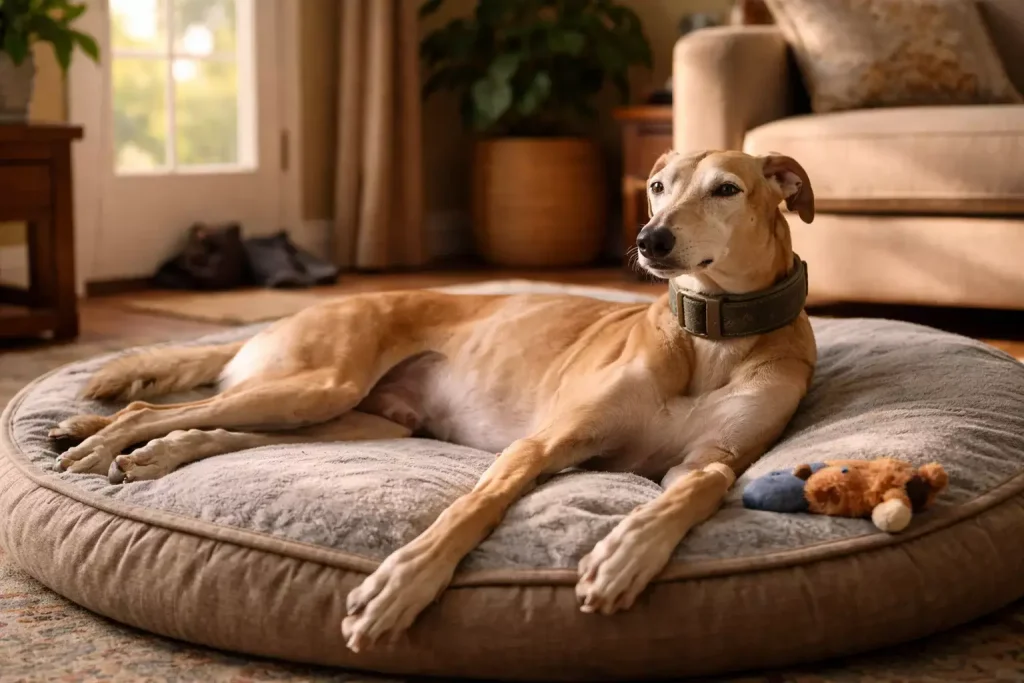
The most common surprise for new adopters is how much greyhounds sleep. A retired racer will happily spend 16 to 18 hours a day resting, often in positions that look anatomically improbable. They are not lazy — they are athletes recovering from a career of high-intensity exercise, and their natural instinct is to conserve energy between bursts of activity. Two 20-minute walks a day is sufficient exercise for most retired greyhounds, and some will prefer less.
Stairs, glass doors, mirrors, televisions and slippery floors may all be new experiences. A dog that has spent its life in a kennel with concrete floors and outdoor exercise paddocks has never encountered a laminate hallway or a full-length mirror. These adjustments are amusing in hindsight but can be genuinely stressful for the dog in the moment. Go slowly, let the dog explore at its own pace, and do not force exposure to new stimuli before it is ready.
Recall — the ability to come back when called — is the biggest training challenge with ex-racers. Greyhounds are sighthounds with a deeply embedded instinct to chase small moving objects. A retired racer that spots a squirrel in the park will pursue it with single-minded intensity and will not hear your whistle until the chase is over. For this reason, most rehoming organisations advise keeping greyhounds on a lead or in secure enclosed spaces for off-lead exercise, at least until recall training is well established. Some greyhounds never achieve reliable recall, and responsible ownership means accepting that limitation rather than testing it in an open field.
The reward for patience is a companion of extraordinary gentleness. Greyhounds are among the calmest, most affectionate breeds — a temperament that surprises people who associate them with speed and competition. An ex-racer that has settled into its new home is typically quiet, low-maintenance and content to spend the evening lying next to you on the sofa. From track to sofa is not just a phrase — it is the daily reality for thousands of retired greyhounds across the UK, and the transition, when managed well, is one of the most rewarding experiences in dog ownership.