
Greyhound Racing Safety: Track Injuries, Veterinary Standards and CPD
Best Greyhound Betting Sites – Bet on Greyhounds in 2026
Loading...
Every licensed GBGB greyhound meeting in the UK is attended by an independent veterinary surgeon. No exceptions, no cost-cutting shortcuts — the vet is there from the first race to the last, with authority to withdraw any dog from competition on welfare grounds. In 2026, participants across the sport completed more than 580 hours of continuing professional development focused on greyhound care, covering everything from injury recognition to kennel management and first-response protocols.
Those are the structural safeguards. Whether they are sufficient depends on your perspective, but the data on which both sides of the welfare debate draw is publicly available and measurably improving. Safety on the sand is built from track maintenance, veterinary oversight, regulatory enforcement and the ongoing education of the people who handle and train the dogs. This article examines each layer of that system and presents the numbers that define its current performance.
Injury Prevention: Track Standards and Maintenance
The first line of defence against injuries is the racing surface itself. Sand tracks require constant maintenance — grading, watering, testing for compaction and depth, replacing worn material. At Towcester, the 2026 investment programme under Orchestrate’s management included approximately 300 tonnes of new sand, new grading equipment and a revised maintenance regime designed to produce a more consistent surface. That investment was not cosmetic; it was driven by the understanding that surface quality is the single most controllable variable in greyhound injury rates.
The GBGB’s 2026 data recorded an injury rate of 1.07% — 3,809 injuries from 355,682 race starts — the lowest figure in the history of the measurement programme. On-track mortality stood at 0.03%, half the level recorded in 2020. Mark Bird, Chief Executive of the GBGB, has been particularly direct about one category of outcome: the practice of destroying healthy greyhounds for economic reasons. The Board considers this unacceptable, and the data shows a 98% reduction since 2018 — from 175 dogs to just three in 2026.
Track inspections are a regulatory requirement. GBGB officials conduct scheduled and unannounced visits to licensed stadiums, assessing surface condition, running rail integrity, trap mechanism safety and kennel facilities. Any deficiency identified during an inspection must be remedied before the next meeting, and persistent non-compliance can result in sanctions including suspension of the stadium’s licence. The inspection regime is not perfect — no system of periodic visits catches every issue — but it creates a baseline standard that every track must meet.
Bend geometry and track design also influence injury patterns. Wider bends produce fewer crowding injuries because dogs have more room to navigate turns without clipping each other. Towcester’s unusually wide bends — capable of accommodating eight dogs abreast — are a structural safety feature that reduces the collision risk inherent in tight-circuit racing. Not every UK track has this advantage, and injury rates vary between venues partly as a function of track geometry.
Running rail design is another factor. The rail must be smooth enough to prevent snagging if a dog clips it, and positioned at a height that minimises the risk of impact injuries. The starting traps themselves are subject to mechanical checks before every meeting — a misfiring trap can cause a dog to stumble at the break, which is both a safety issue and a competitive one. These details are invisible to spectators but central to the daily reality of track safety management.
Veterinary Oversight and Reporting
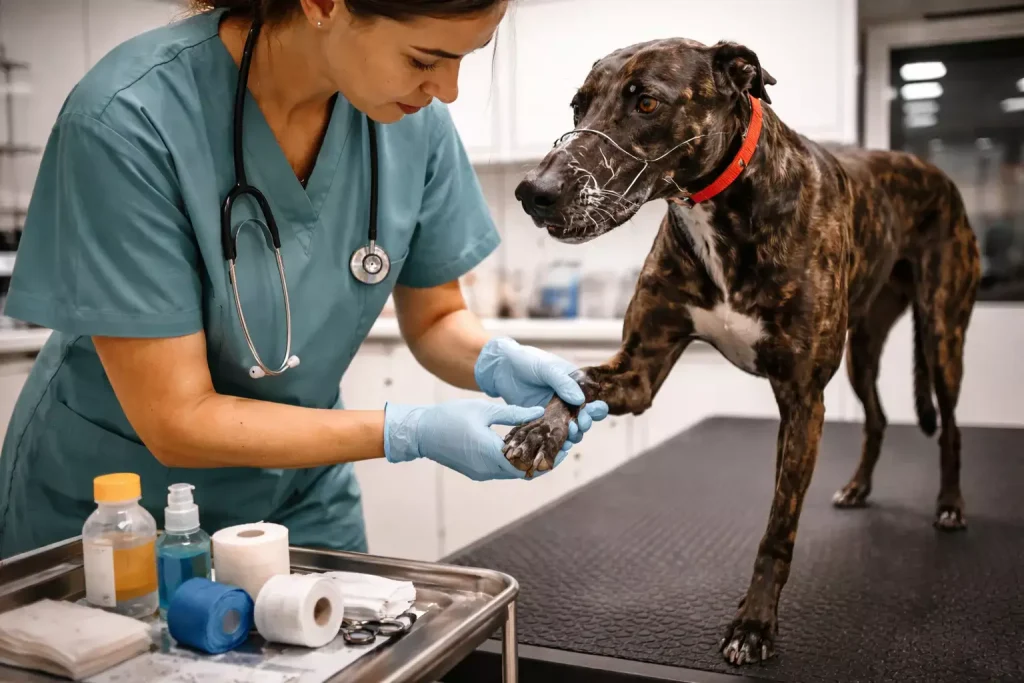
The independent vet at each meeting operates under GBGB rules that give them considerable authority. They inspect every dog before it races — checking for signs of injury, illness or distress — and have the power to withdraw any runner they consider unfit to compete. Post-race, they examine any dog that appears to have suffered an injury during the race, and their findings are recorded in the official meeting report. This data feeds into the national injury and mortality statistics that the GBGB publishes annually.
The reporting system is the mechanism that produces the numbers both supporters and critics cite. Every injury, every withdrawal, every fatality is logged against a specific meeting, race and dog. The data is aggregated nationally and published in the GBGB’s annual welfare report, which provides the headline figures — the 1.07% injury rate, the 0.03% mortality rate, the retirement outcomes — that form the basis of the public welfare debate.
Critics, including parliamentary voices, use the same data set to draw different conclusions. An Early Day Motion tabled in the House of Commons cited cumulative figures showing more than 4,000 greyhound deaths or euthanasias between 2017 and 2026, with over 35,000 injuries recorded in the same period. Those absolute numbers are the product of a high-volume industry: hundreds of thousands of race starts per year across 18 stadiums mean that even a low percentage translates into a large count. The percentage trend is downward and sustained; the absolute count remains substantial because the denominator is so large.
For anyone trying to form a view on greyhound racing safety, both lenses are necessary. The percentage data shows a sport that is measurably safer than it was six years ago. The absolute data shows a sport where thousands of injuries still occur annually. The veterinary oversight system captures and reports both, which is itself an accountability mechanism — without transparent data, neither improvement nor criticism would be possible.
Continuing Professional Development in the Sport
The 580-plus hours of CPD completed by industry participants in 2026 represent a structured programme managed through the GBGB’s welfare strategy. The training covers a range of topics directly relevant to greyhound care: injury recognition, kennel hygiene, nutrition, exercise management, first aid, and the specific responsibilities of trainers, kennel hands and racing staff.
CPD is not optional. The GBGB requires licensed trainers and their staff to complete a minimum number of training hours each year as a condition of maintaining their licence. The courses are provided free of charge, removing the financial barrier that might otherwise discourage participation. The 580-hour total across the sport in 2026 was the highest figure since the programme was formalised, and the GBGB has indicated that it expects the number to continue rising as new modules are introduced.
The rationale is straightforward: the people who handle greyhounds every day are the most important link in the welfare chain. A well-maintained track and a competent vet can only do so much if the dog arrives at the stadium in poor condition because its trainer did not recognise the early signs of a muscle strain, or because the kennel environment was inadequately managed. CPD addresses that gap by ensuring that everyone involved in the sport has a baseline level of knowledge and an ongoing obligation to update it.
For punters, this is background information rather than a direct betting input — but it contributes to the overall integrity and sustainability of the sport. A well-trained workforce produces healthier dogs, fewer race-day withdrawals, more consistent form data, and fewer abandoned meetings. All of those outcomes benefit the bettor indirectly, by making the sport more predictable and more trustworthy as a betting medium. Safety on the sand starts with the surface and the vet, but it extends to every person who touches a greyhound from kennel to starting trap.