Greyhound Form Guide: How to Study Dog Form Before Betting
Best Greyhound Betting Sites – Bet on Greyhounds in 2026
Loading...
Greyhound form is the single most important input for any betting decision. It tells you what a dog has done, under what conditions, and against what level of opposition. But form is not just a list of finishing positions — it encompasses grade movement, distance aptitude, course familiarity and trainer patterns. The punter who reads form as a story, not a number, consistently outperforms the one who glances at the last three results and backs the dog with the most ones.
This guide walks through the key dimensions of form study for UK greyhound racing, with a particular focus on how form data applies at Towcester, where five meetings a week and six racing distances produce an unusually rich data set. Reading the form is a skill that improves with practice — and the volume of data available at Towcester makes it an ideal venue to develop that skill.
Reading the Last Six Runs: What to Focus On
Most form displays show the last six runs for each dog, presented as a string of finishing positions read from left to right. A form line of 1-1-2-3-1-1 paints an obvious picture of a dog in strong current form. But the numbers alone are the surface layer. To read form properly, you need to look at the context behind each digit.
The first contextual factor is the grade. A first-place finish in a D4 race is not the same as a first-place finish in a B-grade race. The competition level is qualitatively different, and a dog stepping up from D4 to C-grade is likely to face faster opponents. Form lines do not always show the grade alongside the position, but the Racing Post and Timeform cards do — always check it. A dog that has been winning in lower grades and is now stepping up will face a genuine test that its recent form may not predict.
The second factor is the track. A run at Towcester is not equivalent to a run at Romford or Monmore. Each venue has different characteristics, and form achieved at a flat track may not transfer to Towcester’s gradient. When a dog’s last six runs are split across multiple tracks, give extra weight to the Towcester runs. Course form is one of the most reliable predictors in greyhound racing because it removes the guesswork about how a dog handles a specific venue. At Towcester, where 2,911 graded races were staged in 2026, the volume of course-specific data is substantial enough to build reliable form profiles.
The third factor is the raceform comment. Behind every finishing position sits a narrative — led from traps, checked on the bend, ran on well, crowded and stopped. These comments reveal whether a dog’s result reflected its true ability or was distorted by circumstance. A dog that finished fifth after being severely checked on the first bend may be a better animal than a dog that finished second in an incident-free race. The comment is the context that the number cannot provide.
A useful habit: when studying the last six runs, mentally divide them into two groups — the last two or three (current form) and the earlier three or four (underlying ability). Current form tells you how the dog is performing right now. Underlying ability tells you what the dog is capable of when conditions are right. If current form is below the underlying level, ask why. Is the dog recovering from injury? Has it been poorly drawn? Has the going been against it? If you can identify a temporary cause for a dip in form, and that cause is absent tonight, you may have found a dog whose price does not reflect its true ability.
Grade Progression and Distance Suitability
The UK grading system moves dogs up when they win and down when they lose, though the mechanics are more nuanced than that summary suggests. Grade progression is the trajectory a dog is on — rising, falling or holding steady — and it is one of the strongest predictors of near-term performance.
A dog that has risen two grades in a month is in peak form but is about to face significantly tougher opposition. Its winning streak may end not because it has declined but because the competition has improved around it. Conversely, a dog that has dropped a grade after a string of mid-table finishes may be about to find itself back at a level where it is competitive. The grade drop is a negative signal in the form line but can be a positive signal for tonight’s race if the lower grade brings easier opponents.
Distance suitability adds another layer. Towcester’s six distances — 260 m, 480 m, 500 m, 655 m, 686 m and 906 m — mean that a dog may appear on the racecard at a distance that does not suit its running style. A sprinter with blistering early pace may thrive over 260 metres but struggle at 655 metres where stamina matters more. A stayer with modest acceleration but relentless late pace may look ordinary at 480 metres but dominate at 686 metres or 906 metres.
Distance form — how a dog performs at a specific trip — should be checked separately from overall form. A dog with a form line of 4-5-1-1-3-5 might look inconsistent until you realise that the two first-place finishes were both at 500 metres and the poor results were at 260 metres. That is not inconsistency; it is a distance preference. The racecard usually shows the distance for each recent run, and filtering form by tonight’s distance gives you a far more accurate picture of what to expect.
Course Form: Why Some Dogs Run Better at Specific Tracks
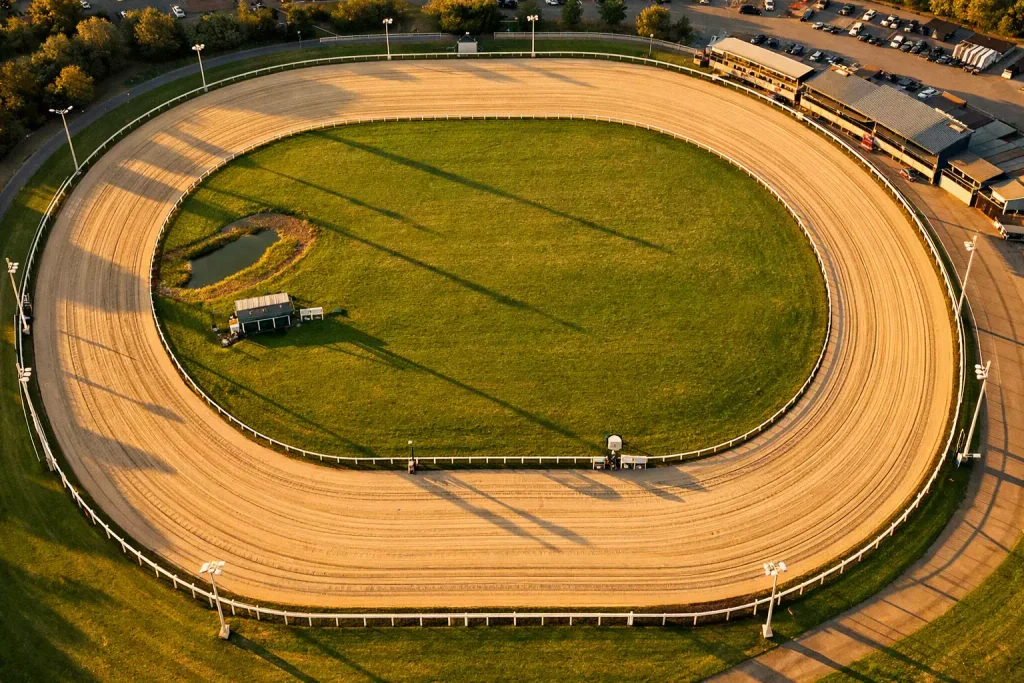
Course form — a dog’s record at a specific venue — is one of the most underrated factors in greyhound betting. The reasons certain dogs perform better at certain tracks are physical: track geometry, surface composition, gradient and bend angles all interact with a dog’s running style, weight and stride length. A dog that handles Towcester’s wide bends and uphill finish may consistently outperform its ratings at this venue while underperforming elsewhere.
The practical question is how much weight to give course form versus form at other tracks. As a rough guide, one good run at Towcester is worth more than two good runs at a venue with very different characteristics. If a dog has three or more Towcester runs on its form line, that is enough data to form a reliable venue-specific assessment. If it has only one, that run should be treated as a strong indicator rather than conclusive proof.
Dogs that are making their Towcester debut present a specific challenge. You have no course form to work with, so you must infer from the dog’s running style and the characteristics of its previous tracks. A strong closer from a flat track is likely to benefit from Towcester’s gradient. A front-runner from a tight track may struggle with the wide bends, which make it harder to establish a clear lead before the first turn. These are probabilistic judgements, not certainties, but they are better than ignoring the track switch entirely.
Over time, regular form study builds a mental database of dogs and their track preferences. At Towcester, with its high volume of meetings and broad range of distances, that database fills up quickly. Within a month of daily form review, you will start recognising names, patterns and preferences — and those recognitions are the foundation on which profitable selections are built.