
Greyhound Starting Prices Explained: SP, Early Prices and Value
 Available in US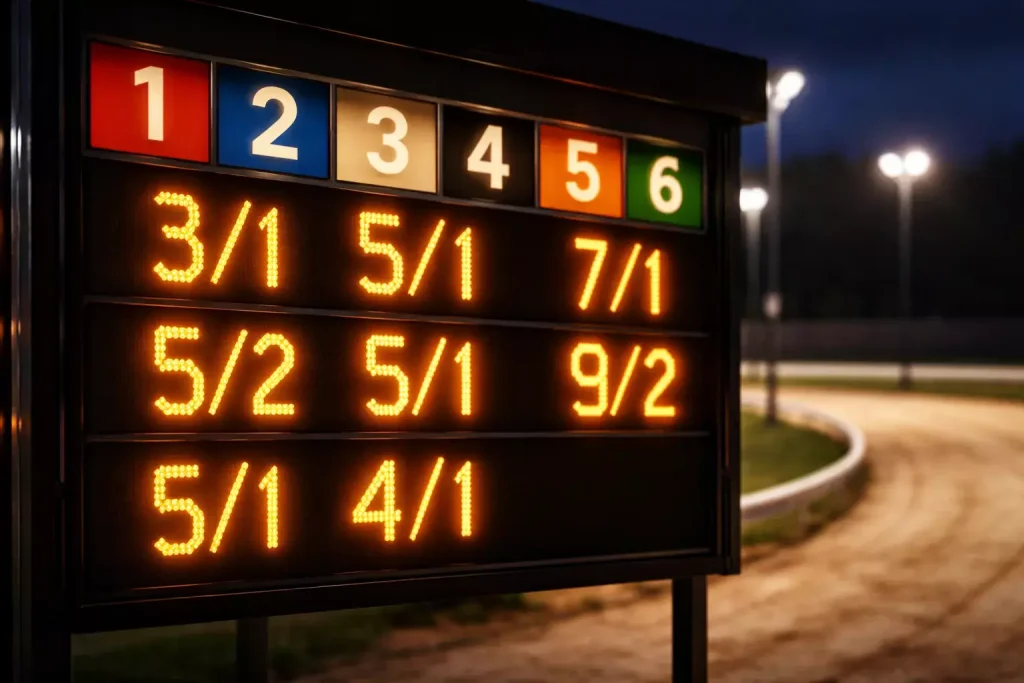
SP is not a fixed number handed down by a central authority. It is the product of a market — shaped by bookmaker pricing, punter demand, market intelligence and the competitive dynamics of a six-runner race. Knowing how that market works, when to take a price before SP, and how to identify situations where the market has mispriced a runner are practical skills that separate consistent winners from the crowd.
The wider context is set out in our Towcester dog results guide.
How Starting Prices Are Set for Greyhound Races
In greyhound racing, the SP is typically determined by an independent SP reporter or by a consensus mechanism that reflects the prices available across the market at the time the race starts. The process is less formal than in horse racing — where an official SP reporter calls the prices on the rails — but the principle is the same: the SP represents the best available price across the market at the off.
Bookmakers set their initial prices — sometimes called tissue prices — based on their assessment of each dog’s chances. This assessment draws on form, trap draw, going conditions, trainer record and any other information the compiler considers relevant. The tissue price is a starting point, not a final answer. As money flows into the market — punters backing certain dogs — the prices adjust. A dog that attracts heavy support will see its price shorten (from, say, 3/1 to 2/1), while dogs that attract little interest will drift (from 5/1 to 7/1).
The movement between tissue price and SP is the market in action. It reflects the collective judgement of everyone who has bet on the race — casual punters, serious form students, people acting on inside information, and the bookmakers themselves adjusting their book to manage risk. The SP, then, is not a prediction of the result; it is a snapshot of market opinion at a single moment in time.
An illuminating example from the English Greyhound Derby: Jaytee Jet in 2016 was the last Derby favourite to win at SP. In the thirteen finals since, seven winners have gone off at 5/1 or longer. That pattern tells you something important about SP in top-level greyhound racing: the market’s best guess (the favourite) is wrong more often than it is right, and the value often lies with the dogs the market underestimates.
Early Prices vs SP: When to Take the Price
Most bookmakers publish early prices for greyhound meetings several hours before the first race. These prices are available to take immediately — if you back a dog at the early price, that is your price regardless of what happens to the SP later. The question of whether to take the early price or wait for SP is one of the most practical decisions a greyhound punter faces.
The case for taking early prices is strongest when you believe a dog will attract support and its price will shorten. If you assess a dog as a strong selection at 4/1 in the morning, and you expect the market to move it to 3/1 or shorter by the off, taking 4/1 early locks in better value. This happens regularly with well-fancied dogs at Towcester — once the serious form students begin backing a selection in the hours before the meeting, the price contracts.
The case for waiting is strongest when you think the early price is too short, or when you want to see late market information before committing. Late support patterns — a sudden surge of money on a particular dog in the last fifteen minutes before the off — can signal information that was not available when the early prices were set. Trainers, connections and sharp bettors tend to act late, and their activity can move the market meaningfully. If you wait, you might catch a price drift on a dog that was over-bet early, or you might identify a late mover that the early market missed.
The bookmaker’s margin — the overround — is built into every market. In a six-runner greyhound race, the overround typically sits between 115% and 130%, meaning the bookmaker expects to retain 15% to 30% of the total wagered. The BGRF’s voluntary contribution from bookmakers stands at 0.6% of turnover, a fraction of the margin that operators build into each race. Understanding the overround helps you calibrate your expectations: you are betting into a market that is structurally tilted against you, and finding value means identifying dogs whose true win probability exceeds what the price implies.
Finding Value in Towcester Greyhound Markets
Value exists when the odds offered on a dog are higher than its true probability of winning. If a dog has a genuine 25% chance of winning (fair odds of 3/1) and the market offers 5/1, backing it at 5/1 is a value bet — even if it loses three times out of four. Over a large number of bets, value selections produce profit even with a modest strike rate, because the returns on winners more than compensate for the cost of losers.
How the markets are built is in the betting guide.
At Towcester, value tends to appear in specific situations. Dogs returning from a poor run caused by interference (checked on the bend, slow away) are often underpriced on their next start, because the market underweights the trouble-in-running narrative and overweights the headline result. Dogs switching to a more favourable trap draw — from trap 6 last time to trap 1 tonight — may not see their price fully reflect the statistical advantage of the better draw. Dogs trained by in-form kennels at a track whose gradient and surface they know intimately are another recurring source of value, particularly in lower grades where market pricing is less efficient.
The discipline of value betting requires patience and record-keeping. You will lose more bets than you win — that is a mathematical certainty when you are backing dogs at longer prices. What matters is the long-term profit and loss. A strike rate of 20% at an average price of 5/1 produces a healthy return on investment. A strike rate of 40% at an average price of 6/4 produces a similar return through a different route. Both are valid, and both require the same thing: the ability to identify when the market has priced a dog incorrectly and the nerve to act on that assessment consistently, even when the short-term results are discouraging.
