
Towcester Greyhound Live: Streaming, Updates and In-Play Data
 Available in US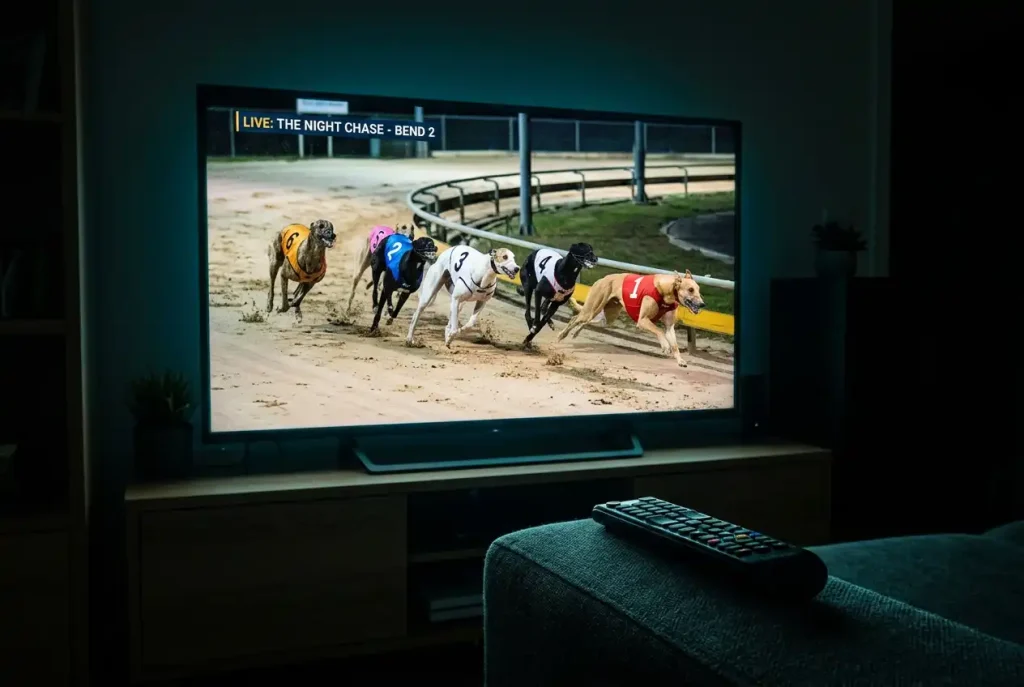
That access matters because greyhound racing is fast. A 480-metre race at Towcester lasts roughly thirty seconds. There is no half-time analysis, no slow build-up, no tactical mid-race adjustment you can study. Either you are watching live and absorbing what happens in the moment, or you are relying entirely on numbers and comments after the fact. Both approaches have value, but live viewing adds a dimension that no results page can replicate: you see how a dog breaks from the trap, how it handles the bends, whether it has to check its stride because of crowding, and how it responds to the uphill finish. Those observations feed directly into your form study and your next bet.
The wider context is set out in our Towcester dog results guide.
Where to Watch Towcester Greyhounds Live
The primary route to live Towcester coverage is through online bookmakers. Almost every major UK-licensed operator streams greyhound racing as part of their standard offering. Bet365, William Hill, Paddy Power, Coral, Ladbrokes and Betfair all carry SIS-distributed greyhound streams. The typical requirement is a funded account, though the minimum deposit is usually low — a few pounds is enough. Once logged in, navigate to the greyhound section, find Towcester on the schedule, and the stream will be available from the first race of the card.
The quality of these streams has improved significantly over the past few years. Most operators now offer HD-quality video with a delay of just two to five seconds from the actual live action. The delay is a function of the broadcast chain — signal from Towcester to SIS, from SIS to the bookmaker’s streaming partner, from the partner to your device. For watching purposes, two to five seconds is negligible. For in-play betting, it is not — but more on that shortly.
With Towcester staging five meetings each week, the streaming schedule is dense. You can find live racing from Towcester on most days of the week, typically with afternoon and evening slots filling different parts of the broadcasting grid. Afternoon meetings slot in alongside other PGR tracks, while evening cards tend to dominate the later portion of the greyhound schedule. If you are trying to watch a specific meeting, check your bookmaker’s schedule page or the Racing Post fixture list, which shows first race times and the number of races on each card.
For those who prefer not to use bookmaker platforms, some racing broadcasters carry greyhound coverage. At The Races occasionally features greyhound content, though its primary focus is horse racing. The SIS-owned RPGTV (Racing Post Greyhound TV) channel, available through Freeview and streaming apps, is the dedicated option and carries a high proportion of PGR meetings, including Towcester. Coverage typically includes pre-race analysis, live commentary and post-race interviews — a richer experience than a bare bookmaker stream.
Betting shops remain the traditional venue for live greyhound viewing in the UK. Every licensed betting shop with SIS screens will show Towcester meetings as they happen. The picture quality tends to be good on the large in-shop screens, and the atmosphere — such as it is — gives you the social element that watching on a phone cannot match. For punters who like to study other people’s reactions, the shop environment also provides informal market intelligence: when experienced regulars are suddenly interested in a particular race, it can be worth paying attention.
In-Play Data: What You Can Track During a Race
Greyhound races are short. The 260-metre sprint at Towcester lasts about fifteen seconds; even the 906-metre marathon is over in under a minute. That brevity limits what you can realistically track in-play compared to, say, a football match or a cricket session. But there are still useful observations to make while the race is running.
The trap break is the first and most critical moment. Within a second of the traps opening, you can see which dogs have broken cleanly and which have been slow away. A dog that stumbles or is left flat-footed at the start has effectively lost two or three lengths before the first bend — at Towcester, where six distances are raced from 260 metres up to 906 metres, early speed matters because the first bend arrives quickly on the shorter trips. On the 260-metre sprint, a slow break is almost always fatal. On the 655-metre or 906-metre distances, a dog has more time to recover, and you may see a late runner sweeping through the field on the final straight.
Bend positioning tells you about a dog’s racing style. Rail runners — those that hug the inside — cover less ground but risk being squeezed if another dog drifts in. Wide runners take longer routes but often have cleaner runs. At Towcester, the bends are wide enough to accommodate up to eight dogs abreast, which means there is more room for wide runners than at tighter tracks. Watching how a specific dog navigates the bends gives you information that no results page captures in full.
The uphill finish is the other element to watch carefully. Towcester’s 6-metre gradient means dogs decelerate visibly on the run to the line. A dog that looks comfortable three lengths clear at the final bend can be caught by a stronger stayer on the climb. If you notice a dog consistently being caught in the closing stages, it is a stamina issue that will recur — and that knowledge is immediately useful for your next bet on the same animal.
Using Replays for Post-Race Analysis
If live viewing is about absorbing the race in the moment, replays are about studying it with purpose. Most bookmaker platforms and dedicated racing sites retain replays for at least a week, and some keep them for months. RPGTV’s archive is particularly useful for Towcester, as it often includes the full pre-race build-up and commentary alongside the race footage.
When each meeting runs is in the race times.
The value of replays lies in selective attention. During a live race, your eyes naturally follow the leader. In a replay, you can watch the third or fourth dog instead — the one that was checked on the first bend, or the one that made up five lengths from the back of the field. These are the runs that produce the most valuable insights for future betting. A dog that was beaten four lengths but had a troubled passage might be the best selection in tomorrow’s card if it draws a better trap.
A structured replay routine helps. Pick one race from yesterday’s card — ideally a race where you had a bet or are considering a bet on one of the runners next time out. Watch it three times: once following the winner, once following the dog you are interested in, and once watching the pack as a whole to see how the race flow affected everyone. Note down whether any dog was physically impeded, whether the going appeared to change visibly (a splashy track looks different from a dry one on camera), and whether any runner showed signs of tiring before the finish.
Replays also reveal things that raceform comments sometimes understate. A comment that says “bumped bend one” might describe anything from a minor brush to a serious collision that cost three lengths. Only the video tells you which one it was. Over time, you will notice that some raceform commentators are more generous with their descriptions than others — knowing that calibration is part of becoming a better form reader.
One final note: replays and live streams are visual tools, but they work best alongside data. Watch the replay while looking at yesterday’s full result card on a second screen or a printout. When you see something on camera — a dog clipping the running rail, for example — check it against the raceform comment and the sectional time. If the sectional was slow and the comment confirms interference, you have a triangulated view of what happened. That triple confirmation — time, comment, video — is the gold standard of form analysis, and it is available for free to anyone willing to spend ten minutes per race.
