
Towcester Greyhound Racecards: Where to Find Them and How to Use Them
 Available in US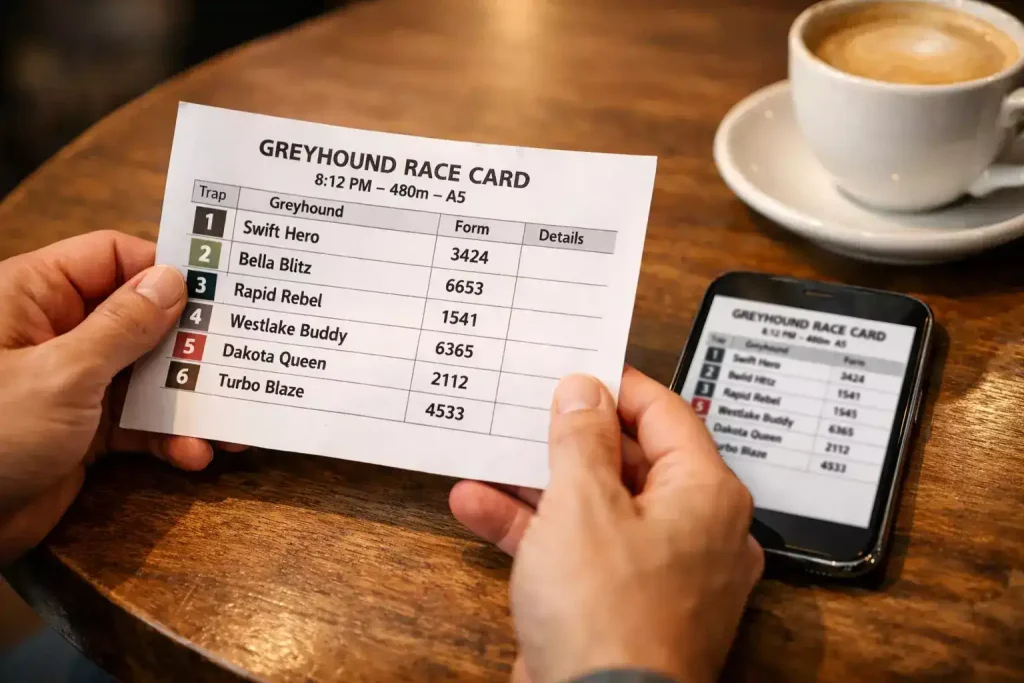
The difference between a profitable approach and a chaotic one often comes down to how efficiently you process the card. Most of the information on a racecard is useful; not all of it is equally important for every race. Knowing where to find the card, which indicators to focus on, and how to convert that data into a selection workflow is the practical skill that separates consistent punters from occasional ones. Card to cash is the goal — and the route starts here.
The full picture is in our Towcester dog results guide.
Where to Find Towcester Racecards Online
The most comprehensive racecards for Towcester are published by Racing Post and Timeform. Both platforms provide full pre-race data for every runner: form lines going back six runs, trainer and kennel details, predicted times, sectional data where available, and analyst comments or ratings. Racing Post racecards are free to access in their basic form, with premium features (including Timeform speed ratings and detailed analyst verdicts) available to subscribers. Timeform’s own site offers a similar structure with slightly different presentation and its own proprietary ratings system.
Sporting Life is another strong option, particularly for punters who prefer a cleaner visual layout. Its racecards include form, trap draws and starting price forecasts, and the site is entirely free. The trade-off is slightly less analytical depth compared to Racing Post or Timeform — you get the data, but less interpretation layered on top.
Bookmaker sites publish racecards as part of their betting interface. If you already have an account with bet365, Coral, Ladbrokes or William Hill, you can view the Towcester racecard directly from the greyhound section. These cards are functional rather than analytical: they show trap draws, recent form figures and starting prices, but typically lack the sectional data, analyst comments and speed ratings that the specialist platforms provide. They are adequate for quick reference but insufficient for serious form study.
The GBGB website publishes official racecards that include every regulatory detail — grading, weight, and race conditions. It is the definitive pre-race document, though it lacks the commercial overlays (ratings, tips, predicted prices) that make the third-party platforms more useful for betting purposes.
A practical approach: use Racing Post or Timeform as your primary racecard source for analytical depth, and cross-reference with your bookmaker’s card for live pricing. The racecard typically appears three to four hours before the first race, which gives you a window to study the card during the afternoon for evening meetings, or over breakfast for afternoon cards.
Key Racecard Indicators for Towcester Bettors
Every racecard contains a lot of data. At Towcester, certain indicators carry more weight than at other tracks because of the venue’s specific characteristics — the 6-metre gradient, the wide bends and the sand surface. Here are the fields to prioritise when you scan the card.
Trap draw is the first thing to check. At Towcester, trap 1 produces roughly 20% of all winners, well above the theoretical 16.6% share that each of six traps would produce in a perfectly neutral system. This bias toward inside traps is driven by the track geometry: dogs in trap 1 have the shortest route to the first bend and the protection of the running rail. When you see a dog with strong recent form drawn in trap 1 or 2, the racecard is telling you the conditions are favourable. A dog drawn in trap 5 or 6 faces a genuine structural disadvantage that needs to be offset by superior ability or early pace.
Recent form figures appear as a string of numbers — typically the finishing positions from the last six runs, read from left to right with the most recent run on the right. A form line of 3-2-1-1-2-1 shows a dog in excellent current form that has been winning or placing consistently. A form line of 5-6-4-5-3-2 suggests an improving trajectory — each run is better than the last. Context matters: the grade and track for each run are usually shown alongside the form figure, so you can tell whether a dog’s recent first place came in a D4 at a weaker track or in a B-grade at Towcester.
Predicted or calculated time is shown on some platforms and represents the racecard compiler’s estimate of what each dog is likely to run. These predictions are based on recent form adjusted for going, grade and trap draw. They are not gospel, but they provide a useful starting point for identifying the likely front-runners and the potential closers in a race.
Trainer name tells you who is preparing the dog. At Towcester, certain trainers — Mark Wallis, Patrick Janssens, Kevin Hutton — have significantly higher strike rates than the average. When you see a familiar name next to a well-drawn dog in good form, the convergence of positive factors is worth noting.
Weight fluctuations between a dog’s last run and tonight’s entry can signal fitness changes. A stable weight across several runs suggests consistency. A sharp drop may indicate the trainer has sharpened the dog for a specific target, or it may indicate a problem. The racecard shows the declared weight, and comparing it to the weight from the dog’s previous runs (visible in the form line) takes seconds.
Pre-Race Workflow: From Racecard to Selection
A structured approach to the racecard prevents you from being overwhelmed by data. Here is a workflow that takes roughly ten to fifteen minutes per meeting and produces a shortlist of races where you have a genuine opinion.
Start by scanning the full card quickly — every race, every trap draw, every form line. Do not stop to analyse anything yet. The goal is to identify the three or four races where something catches your eye: a well-drawn favourite, an improving dog stepping up in grade, a dog returning to Towcester after a break. Mark those races and ignore the rest for now.
For each marked race, go deeper. Check the trap draw against Towcester’s bias pattern. Read the raceform comments from each runner’s last two starts — not just the positions, but the narrative. Look for interference notes, slow starts or strong closing runs that might not be reflected in the headline form figure. Compare predicted times across the field to identify the likely pace of the race: if two dogs are both fast starters drawn in traps 1 and 2, they may cut each other’s throats on the first bend, leaving an opportunity for a closer from the outside.
Finally, check the going report for tonight’s meeting. If it has shifted significantly from the going on which your selected dogs last ran, adjust your expectations. A dog whose best form is on fast going may struggle if tonight’s card is on slow ground, and vice versa. This single check — going comparison between last run and tonight — catches more punters out than almost any other factor, and it takes less than thirty seconds.
Reading the result afterwards is in how to read results.
The output of this workflow is not a guaranteed winner. It is a shortlist of one to three bets where the racecard data supports your selection, the conditions are favourable, and the price represents fair value or better. That is all any disciplined approach can deliver — but it is significantly more than guessing, and at Towcester’s five-meeting-a-week cadence, small edges compound fast.
